

In the modern digital economy, the most valuable insights are locked away behind web pages. From competitor pricing and market trends to real estate listings and social media sentiment, this data is the lifeblood of smart business decisions. The key to unlocking it is web scraping.
Getting started seems easy. A developer fires up a simple script, pulls the title from a webpage, and for a moment, everything works perfectly. But this initial success is deceptive.
Web scraping is not a single task. It is a constant, complex battle against a rapidly evolving web. What starts as a simple script quickly becomes a fragile, time-consuming infrastructure project.
The real question is not if you can build a web scraper, but if you should.
This article explores the “why” and “when” of switching from a do-it-yourself (DIY) scraping setup to a professional web scraping API. The answer can be the difference between getting high-quality data and getting a high-stress maintenance nightmare.
The “Do-It-Yourself” Scraping Trap
Almost every scraping journey begins with the “20-line wonder script.” Whether using Python with Requests and BeautifulSoup or C# with HtmlAgilityPack, a developer proves the concept. “Look,” they say, “I can get the data!”
This success is validating. But the trap is set.
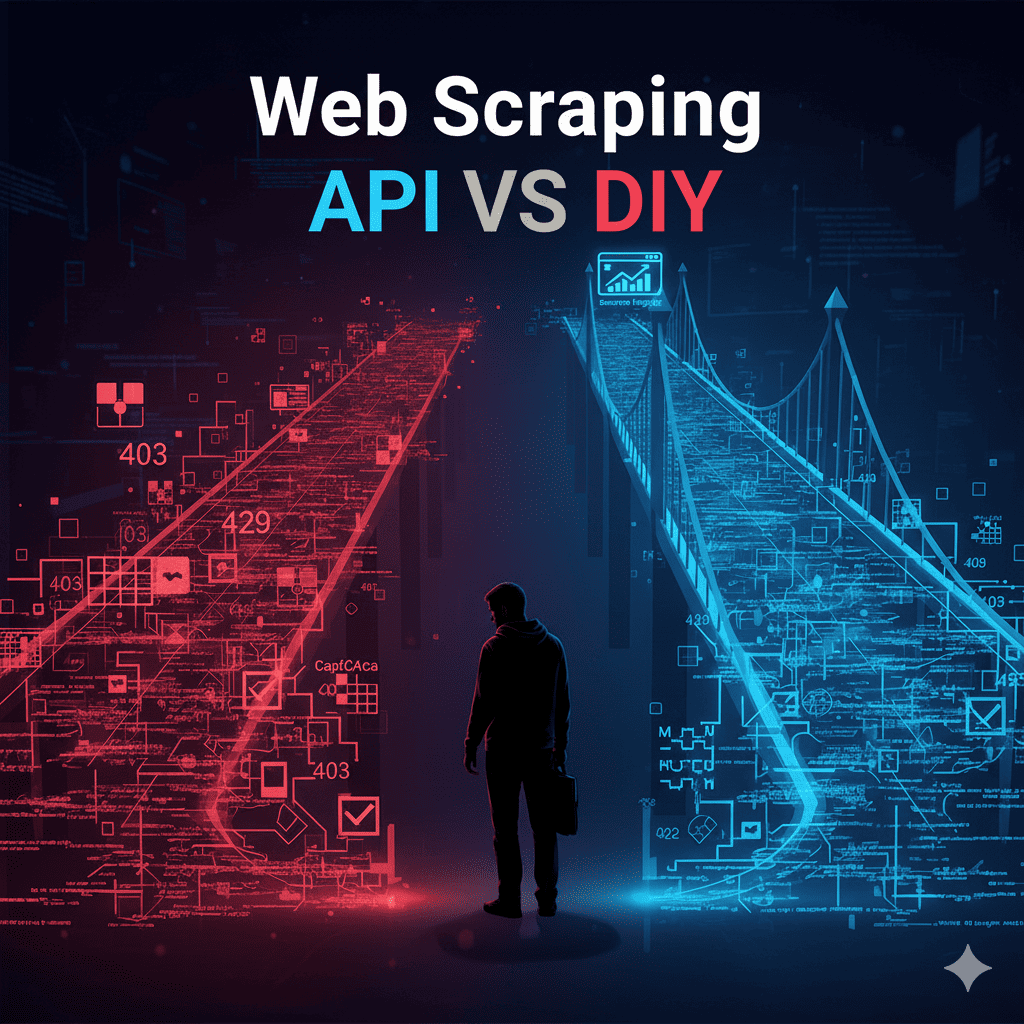
The script is deployed. It runs for a day, maybe a week. Then, the 2 AM email arrives: the scraper is down. A website changed its layout. Or worse, the server’s IP address is now permanently blocked, showing nothing but a 403 Forbidden error.
This is the “DIY scraping trap.” The developer’s job instantly shifts from using data to fighting for access. They are pulled away from building core product features to debug a broken selector or figure out why a CAPTCHA is suddenly appearing.
What went wrong? The script failed to account for the reality of the modern web: websites actively do not want to be scraped at this level. Scaling a simple script from one page to one million pages is not a linear challenge. It is an exponential one.
Why DIY Web Scraping Fails at Scale
The gap between a simple script and a reliable, production-grade scraping system is vast. It is filled with complex, specialized challenges that are full-time jobs in their own right.
Challenge 1: IP Blocks and Rate Limiting
This is the first and highest wall you will hit. Websites monitor for non-human behavior. If your server’s single IP address sends 1,000 requests in a minute, it is an obvious red flag.
- Rate Limiting: The site’s servers will start responding with 429 “Too Many Requests” errors, slowing your scraper to a crawl.
- IP Bans: Afterrepeated offenses, the site will permanently ban your server’s IP address. Your scraper is now completely blind.
Challenge 2: The Proxy Labyrinth
The “solution” to IP bans is to use proxy servers. This means routing your requests through different IP addresses to distribute the load and appear as multiple, different users.
This is not a simple fix. It opens a new world of complexity:
- Datacenter Proxies: These are cheap and fast, but they come from known data centers. Websites easily identify and block entire ranges of these proxies.
- Residential Proxies: These are IP addresses from real home internet connections. They are far more effective but are much more expensive and complex to manage. Understanding the different proxy types is a deep subject in itself.
- Proxy Management: You cannot just use one proxy. You need a pool of thousands of rotating proxies. You must track which proxies are banned, which are slow, and which are country-specific. This is a massive infrastructure task.
Challenge 3: CAPTCHAs and “Are You a Robot?” Walls
The moment a site detects robotic behavior, it will present a CAPTCHA. These “Completely Automated Public Turing test to tell Computers and Humans Apart” are designed specifically to break scrapers.
Suddenly, your scraper needs to solve complex visual puzzles, click on fire hydrants, or solve audio challenges. While third-party CAPTCHA-solving services exist, they add another layer of cost, integration, and fragility to your system.
Challenge 4: JavaScript Rendering Hell
The modern web is built on JavaScript. Content in frameworks like React, Vue, and Angular does not exist in the initial HTML. It is loaded after the page loads, often based on user interaction.
A simple scraper that just downloads the static HTML will find a blank page.
The only way to solve this is to use a “headless” browser. This means running a real browser like Chrome (using tools like Puppeteer or Selenium) on your server. This is resource-intensive. A single instance can consume gigabytes of RAM and significant CPU, making it incredibly expensive and slow to scale. This is exactly the problem a web scraping API with JS rendering capabilities is built to solve.
Challenge 5: Constant Website Structure Changes
Scrapers are brittle. They rely on specific HTML structures, like div class="product-title" or id="price".
The moment a website’s developer refactors the code or redesigns a page, those selectors break. Your scraper starts returning empty data or, worse, the wrong data. This means you need a dedicated team to:
- Constantly monitor scrapers for failure.
- Quickly reverse-engineer the new site structure.
- Update, test, and redeploy the scraper.
This is not a one-time fix. It is a permanent, ongoing maintenance cost.
The “Why”: Key Benefits of a Web Scraping API
A web scraping API like ScrapingDuck is not just a tool. It is an entire, pre-built infrastructure. It is designed to handle every single one of the challenges listed above as a managed service.
Instead of building a complex system, you make one simple API call.
Benefit 1: Instantly Overcome All Anti-Scraping
This is the primary value. A robust web scraping API is a complete solution for:
- Proxy Management: It maintains a massive, global pool of residential and datacenter proxies.
- IP Rotation: It automatically rotates IPs for every request to avoid blocks and rate limits.
- CAPTCHA Solving: It integrates powerful solvers that handle CAPTCHAs transparently in the background.
- JavaScript Rendering: It uses its own fleet of headless browsers. You just pass a simple parameter and it returns the fully-rendered HTML from any JavaScript-heavy site.
Benefit 2: Massive Scalability on Demand
Your local script can handle 10 pages. Can it handle 10 million? A web scraping API’s infrastructure is built for this.
You get access to a globally distributed network that can execute millions of requests concurrently. You do not need to provision servers, manage container orchestration, or worry about bandwidth. You just send the requests you need, and the API scales to meet the demand.
Benefit 3: Focus on Your Core Business, Not Infrastructure
This is the key business benefit. Your developers are expensive. Their time is valuable.
- Without an API: Your developer spends 15 hours a week debugging scrapers, managing proxies, and updating selectors.
- With an API: Your developer spends 15 minutes writing one API call. They then spend the rest of the week building the features that actually make your company money.
A web scraping API lets you focus on data analysis and business logic, not the plumbing.
Benefit 4: Reduce Your Total Cost of Ownership (TCO)
Building a DIY system seems cheaper. It is not. Consider the true costs:
- Developer Salaries: The hours spent building and maintaining the system.
- Infrastructure Costs: Servers, databases, and bandwidth for scrapers and headless browsers.
- Proxy Subscriptions: Residential proxy plans are a major, recurring expense.
- CAPTCHA Solving Services: Another monthly bill.
- Opportunity Cost: The value of the features your team could not build because they were busy with scraping.
A web scraping API bundles all of this into a single, predictable cost, which is almost always lower than the true Total Cost of Ownership (TCO) of a DIY solution.
The “When”: Triggers to Switch to a Web Scraping API
How do you know it is time to make the switch? Here are the most common triggers. If you recognize yourself in more than one of these, it is time.
When… You Get Your First IP Ban
This is the “check engine” light. It is your first sign that your simple approach is no longer viable. Do not ignore it.
When… Your Developer Is a “Scraper Mechanic”
Is your most valuable C# developer spending more time fixing broken scrapers than writing new code? Their time is being wasted. This is a critical signal to offload the maintenance burden.
When… You Need to Scrape a JavaScript-Heavy Site
The moment you see the target site uses React, Vue, or Angular, stop. Do not even try to build your own headless browser fleet. This is the exact problem an API’s JS rendering feature is built to solve.
When… You Need to Scale Up
You are moving from 100 pages a day to 100,000. Your current infrastructure will not survive the jump. This is the definition of a scaling problem. Use a service that is already built to scale.
When… You Need Data from Different Countries
A website shows different prices or content based on the user’s location. To scrape this, you need proxies from specific countries (geotargeting). Acquiring and managing these yourself is a nightmare. A good API lets you specify a country with a simple parameter.
When… Data Reliability Is Mission-Critical
Your business decisions depend on this data being timely and accurate. You cannot afford to have your scraper down for two days while a developer figures out a site’s new layout. A web scraping API has a team of experts whose only job is to ensure that data delivery is reliable.
The Choice: Build a Scraper or Get Data?
Ultimately, the decision comes down to a single question:
Is your core business web scraping, or is your core business using data?
If your business is web scraping, you should build your own infrastructure. You will need to hire a dedicated team of engineers, buy proxy plans, and build a system to rival the very websites you are targeting.
For everyone else, the choice is clear.
A web scraping API like ScrapingDuck is the smart, strategic, and cost-effective solution. It abstracts away a mountain of complexity, allowing you to treat web data extraction as a simple, reliable utility.
Stop building infrastructure. Stop fighting with scrapers. Start getting the data you need, today.

